
Probing the baryon cycle requires observations across a range of spatial scales and wavelengths. MISTY currently combines ground-based optical integral-field spectroscopy from Magellan and Keck with space-based imaging from HST and JWST. Work is also underway to expand the observational program toward near- to mid-infrared spectroscopy and H I 21 cm measurements. The figure below illustrates some of the observations and derived properties for one of the MISTY galaxies.

Description of observations
Ground-based IFU
MISTY uses ground-based optical integral-field spectroscopy to map the ionized gas and stellar populations of nearby dwarf galaxies at spatial resolutions of 100–150 pc. Observations are carried out in two complementary spectral modes. A medium-spectral-resolution mode provides broad wavelength coverage (3500–10,000 Å), enabling measurements of multiple emission lines to study ionized-gas conditions and determine direct, temperature-sensitive chemical abundances. A high-spectral-resolution mode covering selected emission lines traces kinematics down to 10–20 km s−1, enabling studies of dwarf-galaxy kinematics, the identification of expanding shells, and the characterization of galactic outflows.
As of August 2026, MISTY has obtained ground-based IFU observations for 46 galaxies in both spectral modes. The survey is designed to reach approximately 200 galaxies, with about 100 observed from Magellan and about 100 from Keck.
MISTY employs two new fiber-fed, lenslet-array integral-field units on Magellan with complementary capabilities. LLAMAS is used for the medium-spectral-resolution mode, while IFUM is used for the high-spectral-resolution mode. Most galaxies require a single IFU pointing to cover the main extent of the galaxy, although some require two or three pointings.
| Characteristic | LLAMAS | IFUM |
|---|---|---|
| Configuration | STD(80) + HiRes | |
| Field of view | 37''×37'' | 22''×24'' |
| Fiber size | 0.75'' | 1.05'' |
| Wavelength coverage | 3500 - 10,000 Å | 6532 - 6750 Å |
| Spectral resolution | R = 2000 | R = 28,000 |
| Primary MISTY measurements | Metallicity and ionization diagnostics | Ionized-gas kinematics |
MISTY uses the Keck Cosmic Web Imager (KCWI), an image slicer IFU, in two configurations to provide the medium- and high-spectral-resolution modes. Galaxies require 1-3 pointings to cover their main extent.
| Characteristic | Medium-R | High-R |
|---|---|---|
| Configuration | medium slicer + BL/RL | small slicer + RH1 |
| Field of view | 16.5''× 20.4'' | 8.4''× 20.4'' |
| Spatial sampling | 0.7'' | 0.7'' |
| Wavelength coverage | 3500 - 10,000 Å | 6240 – 6800 Å |
| Spectral resolution | R = 2000 | R = 17,000 |
| Primary MISTY measurements | Metallicity and ionization diagnostics | Ionized-gas kinematics |
MISTY was awarded a large joint HST+JWST observing program in HST Cycle 34 (HST program 18417; JWST program 12660). The program will use HST/WFC3-UVIS and JWST/NIRCam to image 26 MISTY galaxies spanning stellar masses of 106.5–108 M☉ and metallicities of 2–20% solar. The selected filters, shown below, will identify and characterize star clusters from deeply embedded through exposed evolutionary stages using ultraviolet-to-near-infrared photometry. Two narrowband filters will map Hα and Paα emission across the galaxies, resolving ionized gas around young clusters and enabling estimates of dust reddening. A medium-band filter will identify PAH emission in the 3.3 μm feature, tracing small carbonaceous grains typically associated with neutral and molecular gas.

The angular resolution of HST and JWST will yield maps with physical resolutions of approximately 10 pc, providing a substantially sharper view of stellar populations and the interstellar medium than is possible from the ground, as illustrated below. The space-based data will enable the identification of star clusters, resolve the structure of ionized gas, and reveal feedback-driven structures. The data shown below are adapted from HST program 15114, which includes one of the MISTY HST+JWST galaxies.

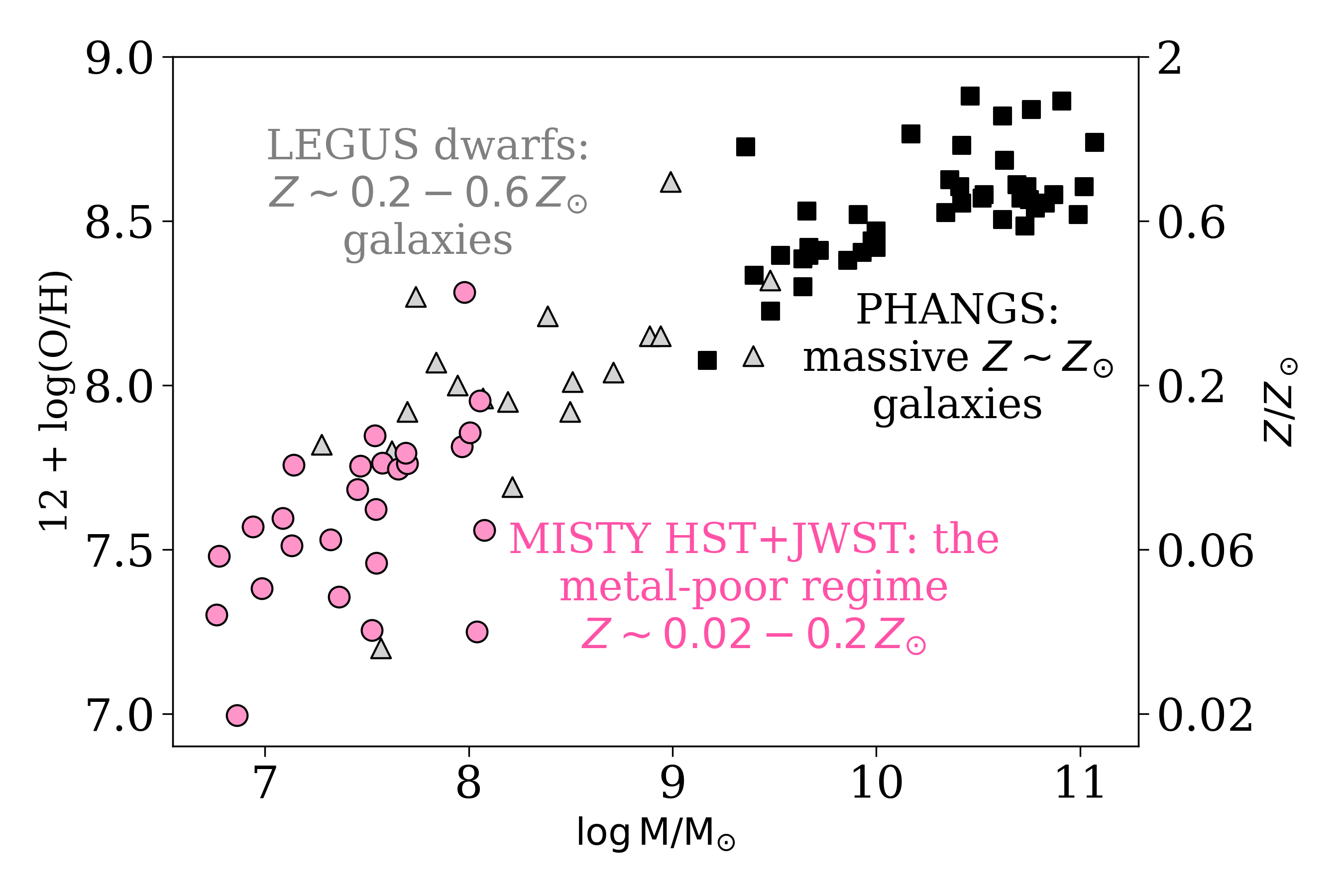
This program adds to a substantial community investment in mapping the baryon cycle across stellar mass and metallicity. MISTY joins the large PHANGS and LEGUS programs, including FEAST and FLEET, which have obtained high-angular-resolution HST and JWST imaging of nearby, more massive galaxies. Together, these data will help establish a coherent and general picture of star-formation regulation within the complex interstellar medium across four orders of magnitude in stellar mass and two orders of magnitude in metallicity.